You've been journalling all wrong.
One 40-minute live session. A simple four-step method to move through what you feel, instead of spiralling in it.
Live and online. Pick your date at checkout.
Voices from the room
From the start it felt like a very safe space to be open, to be myself, and to write from my heart. It enabled me to become more self aware.
You were very warm and welcoming. Thanks for a lovely workshop. It felt rich with possibility.
The content was very interesting and I enjoyed learning more about my inner voice.
You have a warm manner and clear spoken voice which ensures you reach your audience and keep them engaged.
Before you scroll
A small shift
The old way. The method.
- Vent for two pages. Close book. Feel worse.
- Write the same loop three nights in a row.
- Try to "fix" yourself on paper.
- Skip days. Feel guilty. Quit.
- Name the feeling in one line. Stay with it.
- Ask the page one honest question. Let the answer surprise you.
- Process first. Decisions come after, on their own.
- A 6-minute version you can actually keep.
One method. You keep it for life.
I'll teach you a simple four-step way to move through an emotion on the page instead of getting stuck in it. Learn it in 40 minutes. Do it in a few, any time you need it.
Name it.
Put the feeling on the page. The actual word. Not "fine".
Feel it.
Name what it always tells you. The line it repeats, word for word.
Turn it.
Ask the page one honest question. Write the answer that surprises you.
Carry it.
Close with one small thing you can hold for the rest of the day.
- Stop spiralling in your own anxious thoughts.
- Actually process what you feel instead of just recording your day.
- Walk away with a repeatable skill, not a vague good feeling.
Try a 90-second taste
Two steps. Right here. No pen needed.
A tiny preview of how the method feels. Nothing you type leaves this page.

Chandigarh, India · Online worldwide
Who's teaching this
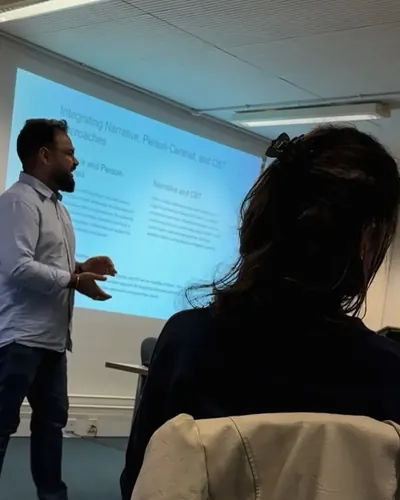
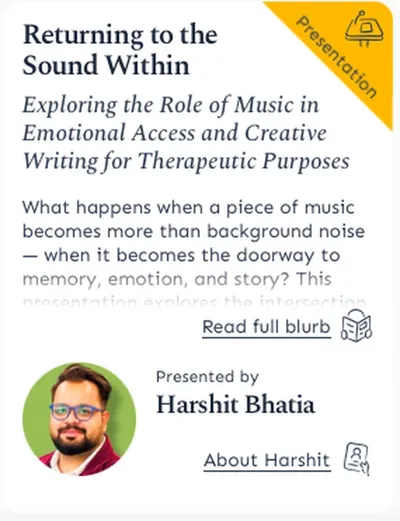
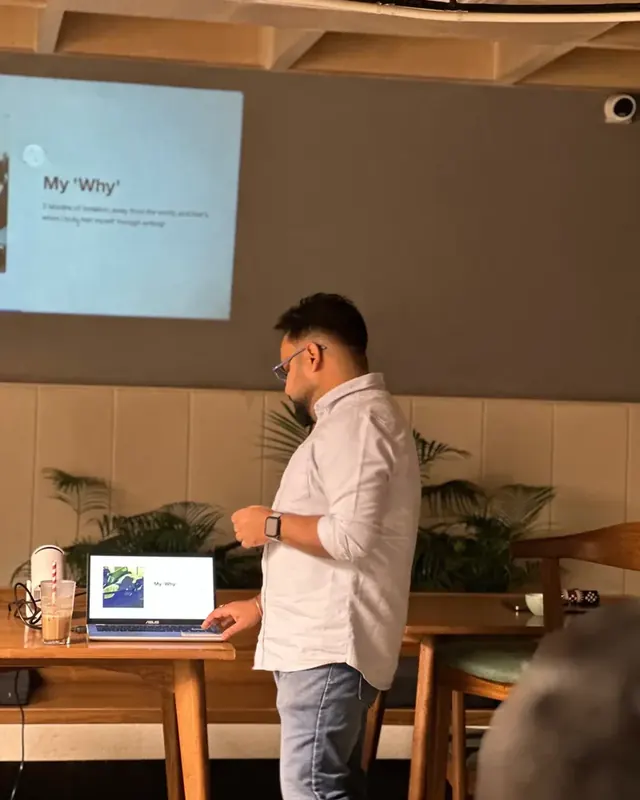
I'm Harshit Bhatia, a writing therapist.
I trained in writing therapy and prompt-based journaling at Middlesex University, UK, where I did my MSc in Creative Writing for Therapeutic Purposes with the Metanoia Institute, London. I also completed an Introduction to Counselling summer programme at the University of Oxford.
For the last few years I have sat with overthinkers, founders, parents and people in their twenties figuring it out. The same thing keeps happening on the page: the loop in their head slows down. This workshop is the method behind that.
-
MSc, Middlesex University
Creative Writing for Therapeutic Purposes
-
University of Oxford
Introduction to Counselling, summer programme
-
Lapidus International, London
"Writing to the Sound Within"
-
Metanoia Institute, London
Trained in narrative & expressive writing


The science underneath
What the research keeps finding.
Structured, expressive writing has been studied for forty years. The pattern is consistent: when you process on the page, the body and mind quiet down.
Less rumination
Expressive writing reduces intrusive, repetitive thinking over time.
Pennebaker & Beall, J. Abnormal Psych.
Lower anxiety
Brief structured writing sessions reduce self-reported anxiety symptoms.
Cambridge / JAMA Psychiatry meta-reviews
Better sleep latency
A short pre-sleep writing practice helps the mind unhook from the day.
Scullin et al., J. Experimental Psych.
Fewer doctor visits
Across 200+ studies, expressive writing is linked to improved physical health markers.
Frattaroli, Psychological Bulletin
Figures are approximate effect sizes drawn from peer-reviewed expressive-writing literature. The method is supportive, not a substitute for clinical care.
By the end of the session
You walk out with this.
-
A quieter head, same night.
Most people feel the loop slow down within the 40 minutes.
-
A 6-minute version you will actually use.
Short enough for a Tuesday. Sharp enough to move you.
-
One real situation, already processed.
We do the method live on something from your week.
-
A name for what you were doing wrong.
So you stop blaming yourself for "not being a journal person".
Voices from the room
I very much enjoyed Harshit's one hour Therapeutic Writing Workshop. From the start he made it very clear that he was not there to judge me in any shape or form. For me it felt like a very safe space to be open and to be myself, and to write from my heart. The workshop enabled me to become more self aware, and alter my perspective in relation to a couple of aspects of my life.
You were very warm and welcoming. Thanks for a lovely workshop! It felt rich with possibility. I think participants would really love that and feel connected to the workshop well after it's done.
Harshit was very prepared for the session. The content was very interesting and I enjoyed learning more about Jung's archetypes and writing about my inner voice.
You have a warm manner and clear spoken voice which ensures you reach your audience and keep them engaged. Numerous interesting observations came from participants including how sounds created a direct route to personal experience, memory and senses.
The session.
What
The 4-Step Journalling Method. A live 40-minute session.
When
Where
Online and live. Joining link sent after you book.
Inside the 40 minutes
Here is exactly what we do.
-
0:00 min
Settle in.
A short grounding so the page does not feel like another task.
-
0:05 min
The reframe.
Why dear-diary journalling stops working, and what to do instead.
-
0:12 min
Live walkthrough.
I take you through all four steps with my own example on screen.
-
0:22 min
You write.
Guided silence. You do the method on your own page, in real time.
-
0:34 min
Q&A.
Bring your stuck points. I answer on mic.
A quiet honesty
Is this for you?
Yes, if…
- You overthink at night and cannot switch off.
- You have journals you started and abandoned.
- You feel things hard and want a way to hold them.
- You want a tool that works in the messy middle of a week.
Probably not, if…
- You want a guided meditation. This is writing.
- You want a certificate or a course. This is a 40-minute skill.
- You are in acute crisis. Please reach out to a therapist or helpline first.
"The page is the cheapest therapist you will ever meet. You just have to know how to talk to it."
Harshit Bhatia
Quick questions.
40 minutes. One method you keep.
Frequently Asked Questions
Do I need to be good at writing?
No. If you can text, you can do this. We are not writing for an audience. We are writing for a clearer head.
Is this therapy?
No. This is a skill session. You learn a method and practice it live. If you want one to one therapeutic work after, that is a separate conversation.
What if I can't attend live?
Add the recording at checkout. You will get it within 24 hours of the session.
How long is it?
40 minutes. We start on time, we end on time.
What do I need to bring?
A pen, a notebook, and forty minutes where nobody will interrupt you. That is the whole kit.
Will I have to share what I wrote?
No. Nothing you write leaves your page unless you choose. You can keep your camera off and your mic muted the entire time.