I did not come to narrative therapy through a textbook. I came to it because I was stuck. Stuck in a version of my own story that no longer served me, stuck in a loop of self-definition that felt more like a cage than a compass. And then someone asked me a question I had never been asked before: "Is that the only story you can tell about yourself?"
That question cracked something open. It did not give me answers. It gave me permission to look again, to look differently. And that, I have since learned, is the heart of narrative therapy.
So, What Exactly Is Narrative Therapy?
Before I share my personal experience, let me ground this a little. Narrative therapy is a form of psychotherapy developed in the 1980s by Michael White and David Epston, working out of Australia and New Zealand. At its core, it rests on a beautifully simple premise: the person is not the problem; the problem is the problem.
In traditional therapy, there is often an impulse to diagnose, to locate the issue inside the person. You are anxious. You are depressive. You are avoidant. Narrative therapy pushes back on that. It invites you to externalize the problem, to separate it from your identity, and to examine the stories you have been living by. Are they yours? Were they handed to you? Do they still fit?
White and Epston drew on the ideas of French philosopher Michel Foucault, particularly his work on how power and discourse shape identity. They also built on the social constructionist thinking of thinkers like Jerome Bruner, whose research on narrative as a mode of knowing showed that human beings fundamentally make sense of their lives through story.
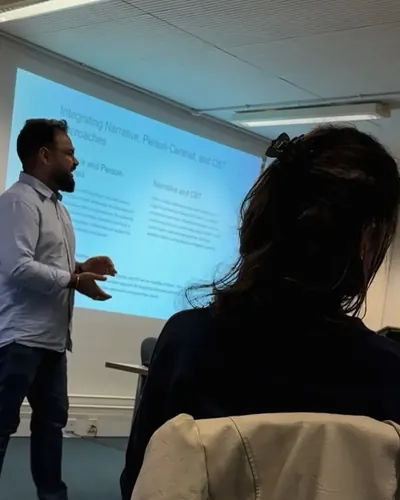
Presenting at the University of Oxford Introduction to Counselling summer programme
My First Encounter
I first encountered narrative ideas during my time studying in the UK. I was exploring therapeutic writing, trying to understand why the simple act of putting words on a page could feel so profoundly healing. The research of James Pennebaker on expressive writing had already opened a door for me. But narrative therapy opened a different kind of door, one that led not just to expression but to re-authoring.
I remember reading Michael White's Maps of Narrative Practice and feeling a strange electricity. Here was a therapeutic framework that treated people as the primary authors of their own lives. It did not pathologize. It did not reduce. It honoured complexity. And it used the very thing I had fallen in love with, storytelling, as its central instrument.
The idea that we live "multi-storied lives" struck me deeply. We are never just one story. We carry many. Some are dominant, repeated so often they feel like facts. Others are thin, barely whispered, waiting to be thickened. Narrative therapy is, in many ways, the art of thickening those alternative stories.
The Key Ideas That Reshaped My Practice
Let me walk through the core principles that have most deeply influenced how I work today.
1. Externalization
This is perhaps the most well-known technique in narrative therapy. Instead of saying "I am anxious," you learn to say "Anxiety visits me" or "Anxiety has been loud lately." It sounds like a small shift in language. It is not. It is a revolution in how you relate to suffering.
When I facilitate writing therapy sessions, I often invite participants to write a letter to their problem, as if it were a character in their life. "Dear Perfectionism, we need to talk..." The results are extraordinary. People who felt trapped suddenly find breathing room. The problem is still there, but now there is space between the person and the problem, space to think, to choose, to respond rather than react.
Research supports this. A 2014 meta-analysis in Counselling and Psychotherapy Research found that narrative therapy techniques, including externalization, showed significant positive effects on personal growth and reduction in depressive symptoms.
2. Unique Outcomes
When we get caught in a dominant story about ourselves, we start filtering everything through it. If the story is "I always fail," then every small stumble confirms it, and every success gets dismissed as a fluke. Narrative therapists listen for unique outcomes, moments that contradict the dominant story.
In my retreats, I have seen this happen again and again. Someone shares a story of helplessness, and then, almost by accident, mentions a moment where they stood up for themselves. That moment is gold. That is the unique outcome. And the work becomes about expanding it, giving it weight, asking: "What does that moment say about who you are?"
3. Re-Authoring
If our identities are storied, then they can be re-storied. This does not mean pretending the past did not happen or slapping a positive spin on genuine pain. Re-authoring is about finding neglected threads in your life story and weaving them into a richer, more nuanced narrative. It is about restoring agency to the storyteller.
I think of a participant from one of my workshops who had spent years defining herself by a relationship that ended badly. Through narrative exercises, she began to notice the parts of her story she had been skipping over: the friendships she had sustained, the career she had built, the courage it had taken to start over. These were not new facts. They were old facts that had been overshadowed by a single dominant plot.
4. Definitional Ceremonies and Witnessing
Michael White adapted the concept of definitional ceremonies from the work of anthropologist Barbara Myerhoff. In these ceremonies, a person tells their story, and a group of witnesses responds, not with advice or analysis, but by sharing what resonated, what images stood out, what the story revealed about the teller's values and commitments.
This is deeply embedded in how I run group sessions. When someone reads their writing aloud and the room holds it, that moment of being truly heard can be more transformative than months of solitary reflection. We are relational beings. Our stories gain power when they are witnessed.
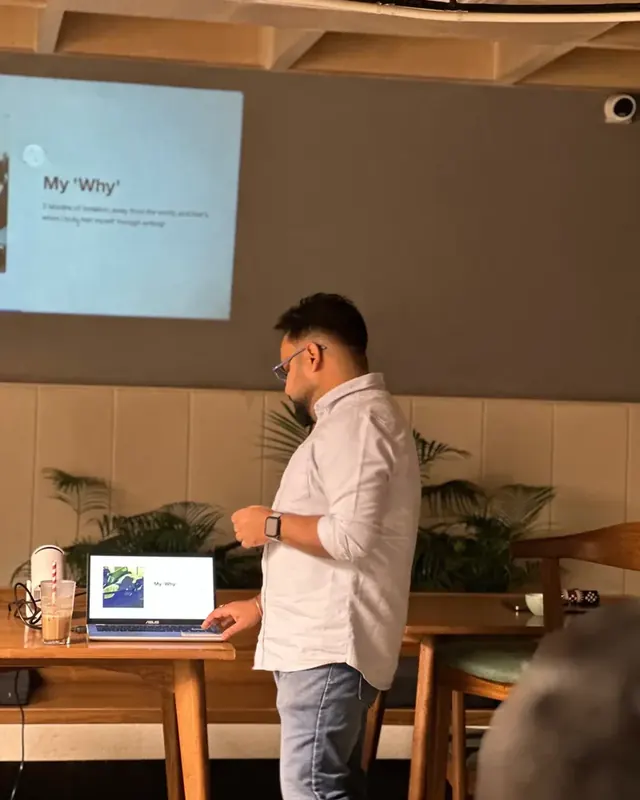
Exploring the "why" behind story in a workshop session
Where East and West Meet in My Work
What has always fascinated me is how naturally narrative therapy resonates with the philosophical traditions I grew up with. In Vedantic philosophy, there is a concept called maya, the idea that much of what we take to be fixed reality is actually a construction, a story we have mistaken for truth. Narrative therapy says something remarkably similar, though in psychological rather than metaphysical language.
The Vedantic inquiry "Who am I?" and the narrative question "What stories have I been living by?" are, in my experience, two sides of the same coin. Both invite you to look beneath the surface narrative and discover something more spacious, more fluid, more true.
In Indian classical music, which I trained in for years, there is the concept of raga: a melodic framework that provides structure while leaving enormous room for improvisation and personal expression. I have come to see narrative therapy in the same way. The framework gives you a structure for exploring identity, but the actual content, the actual story, is entirely yours to shape.
"The Vedantic inquiry 'Who am I?' and the narrative question 'What stories have I been living by?' are two sides of the same coin."
What the Research Says
I want to be honest about this: narrative therapy's evidence base is growing but is not as vast as that of, say, Cognitive Behavioural Therapy. That said, the research that does exist is compelling.
- A 2016 study published in the Journal of Clinical Psychology found narrative therapy to be effective in reducing symptoms of depression, with effects comparable to other established therapies.
- Research by Lopes et al. (2014) in Research on Social Work Practice demonstrated that narrative therapy significantly improved self-esteem and reduced psychological distress in participants.
- A systematic review published in the British Journal of Guidance & Counselling concluded that narrative approaches are particularly effective for people dealing with grief, trauma, and identity-related concerns.
- The Dulwich Centre, founded by David Epston and Cheryl White, continues to publish practice-based evidence from narrative therapy work across diverse communities worldwide.
What I find most meaningful is that narrative therapy has been used effectively across cultures, with Indigenous communities, with refugees, with children, with people who have historically been poorly served by Western clinical models. Its emphasis on respecting local knowledge and personal meaning-making gives it a cultural humility that many approaches lack.

The reading that shaped the journey
How Narrative Therapy Shows Up in My Sessions
I do not practice narrative therapy in a clinical sense. I am not a psychotherapist. What I do is facilitate spaces where narrative ideas inform the process of writing, reflection, and group dialogue. Here is what that looks like in practice:
In a typical writing therapy session or retreat, I might begin with a prompt rooted in externalization. "Write about a time when Fear was in the driver's seat. What did Fear tell you? What did you want to say back?" This is not just a creative exercise. It is an invitation to see your relationship with that emotion differently, to stop being fear and start being someone who has a relationship with fear.
Later, we might move into identifying unique outcomes. "Think of a time when you did something that surprised you, something that went against the story you usually tell about yourself. Write that scene." The energy in the room shifts palpably during these exercises. People light up when they rediscover parts of themselves they had forgotten.
And then there is the witnessing. When participants share their writing and the group responds, not with "you should" or "have you tried," but with "what struck me was" and "the image that stayed with me is," something quietly transformative happens. The writer sees their own story reflected back, and in that reflection, it becomes more real, more solid, more theirs.
Why This Matters
We live in a world that is very good at telling us who we are. Social media algorithms, cultural expectations, family scripts, professional labels. We are constantly being storied by forces outside ourselves. Narrative therapy, and the broader practice of narrative awareness, is an invitation to reclaim authorship.
That does not mean we can write any story we want and make it true. It means we can learn to hold our stories more lightly, to notice when a story is no longer serving us, and to look for the lived experiences that have been overshadowed by dominant narratives. It means understanding that identity is not fixed. It is a living, breathing, evolving narrative.
For me personally, narrative therapy changed the way I listen. When someone tells me their story now, I am not listening for what is wrong with them. I am listening for what the story reveals about what they value, what they are committed to, what they have survived and built. I am listening for the story underneath the story.
And that, I believe, is where the healing begins.
Further Reading
If this resonates and you want to go deeper, here are some starting points:
- Maps of Narrative Practice by Michael White (W.W. Norton, 2007)
- Narrative Means to Therapeutic Ends by Michael White & David Epston (1990)
- Retelling the Stories of Our Lives by David Denborough (Dulwich Centre Publications)
- Acts of Meaning by Jerome Bruner (Harvard University Press, 1990)
- What Is Writing Therapy? — my companion piece on the practice of therapeutic writing
Want to Explore Narrative Practices?
Whether through a retreat, a workshop, or a one-on-one conversation, I would love to help you discover the stories waiting to be told.